At an intersection
Mark the approach, lane, signal or sign, and where each vehicle came to rest. A photograph taken later should be labeled with its date because signals, traffic, and vehicle positions may have changed.
Keep the scene, vehicle, care, and insurance records separate. This is general information, not a conclusion about any particular claim.
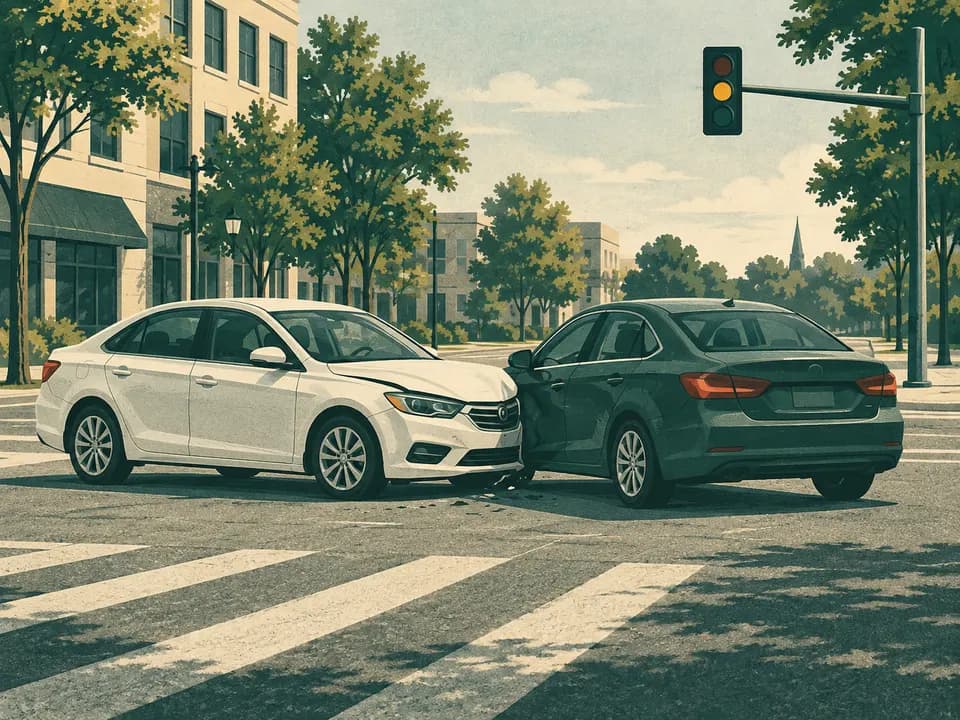
A collision may involve several vehicles, a road condition, a rideshare trip, or an employer-owned car. The useful first description is the exact intersection or road segment, direction of travel, vehicles, people, and what you personally observed. Do not guess at speed or fault when you do not know.
Get appropriate medical care and follow local reporting requirements. When safe, preserve photographs, driver and witness details, the report number, insurance communications, and a dated account of symptoms and treatment.
The drivers, vehicle owners, employers, insurers, and sometimes a road maintainer can hold different records. A lawyer needs the location and sequence before deciding which records to request.
Ask who will review vehicle and insurance records, whether the firm handles multi-vehicle collisions, how it preserves footage, and which state deadlines could matter.
Ask who would handle the work, whether the firm serves the relevant location, how it communicates, and what its written fee and expense terms mean if there is no recovery.
Mark the approach, lane, signal or sign, and where each vehicle came to rest. A photograph taken later should be labeled with its date because signals, traffic, and vehicle positions may have changed.
Record the route, direction, mile marker or exit, lane change, and whether a work zone or disabled vehicle was involved. A crash report can be a starting point, but read it alongside what you personally observed.
Identify the aisle, entrance, backing movement, pedestrian path, and nearby camera locations. A private lot may have several operators with different records.
Keep original files where possible and label later notes as later notes. You can start with what you have; a firm can explain which missing records may matter.
These are possible record holders to ask about. Their involvement and the availability of any record need verification.
Report number, diagram, and any supplement
Vehicle, policy, claim, and repair correspondence
Possible time-limited camera footage at the exact road segment
List each driver, owner, employer, and insurer without assuming a policy applies. Ask which coverage may respond to immediate bills and which person is making the claim. A lawyer or insurer can interpret the actual policy and state law.
NAIC auto insurance consumer guidance ↗
The NAIC resource explains common auto coverage terms. It does not determine coverage or fault for a particular crash.
Hypothetical examples describe questions to investigate, not actual incidents or allegations. State rules and individual facts require review by a qualified lawyer.
Our mission is to make public information about personal injury law firms easier to find, understand, and verify. We organize factual directory records, practical legal education, and links to official sources so people can begin their research with greater clarity.
Our philosophy is accuracy before promotion, clarity before complexity, and corrections whenever reliable evidence shows that a listing has changed. Directory inclusion is informational and is never presented as a legal recommendation.